Because I do drink coffee, sir.
And it's almost ready and I really have nothing to say so I'll just put two quotes from some friends--
Pam (we're coming over for lunch and she's just learned we're vegetarians)--"Oh no! They don't eat meat and we don't eat vegetables!"
Jon--I find Tilda Swinton attractive. Does that make me gay?
Okay, that's it. And, Sam, I'm sorry I posted again. I really think you should devote yourself to more meaningful blogs and just let this one go--I haven't said anything meaningful in AGES, you won't be missing anything.
Showing posts with label Quotability. Show all posts
Showing posts with label Quotability. Show all posts
Sunday, January 13, 2008

Friday, January 11, 2008
"I don't drink coffee, sir."
"I don't drink hot liquids of any kind--that's the devil's temperature."


Tuesday, September 18, 2007
Miscellany but mostly quotes
Sometimes the Safari web browser pops up a little statement that says Safari Cannot Open This Page. It just happened when I clicked on Blogger and I found myself thinking, "Yes you can" in this really positive and nurturing way before I hit the refresh button. This amused me.
On Saturday a bunch of us were having pizza at a friend's house. Our friend Tim walked up to Evie who had just sat down to eat and said, "Well, hello Evelyn. It's very nice to see you this evening." And Evie said in a matter-of-fact voice, "Yeah. Now can you let me eat?" I think I'm going to stop taking my kids outside the house.
Today's ditzy moment (besides the numerous times I quickly walked to a different room, did something totally unrelated to why I went to that room, returned to the room I had originally been in only to realize that I hadn't accomplished the simple thing I'd set out to do): Taking my bowl of soup out of the microwave, salting it and then putting the salt in the microwave and shutting the door.
That gloriously effeminate Mika guy can write both the happiest and saddest songs. Hmm, bi-polar?
I am amazed at the pleasure my kids take in annoying one another. Back and forth, back and forth and they just giggle and giggle and everybody's having such a good time until Evie, in the blink of an eye, explodes with rage. It's so weird and so predictable.
Okay, I'll start with the short quote--
"When asked 'What do we need to learn this for?' any high school teacher can confidently answer that, regardless of the subject, the knowledge will come in handy once the student hits middle age and starts working crossword puzzles in order to stave off the terrible loneliness. Because it's true. Latin, geography, the gods of ancient Greece and Rome: unless you know these things, you'll be limited to doing the puzzles in People magazine, where clues read 'Movie title, Gone ___ the Wind' and 'It holds up your pants.' It's not such a terrible place to start, but the joy of accomplishment wears off fairly quickly."
(You probably already guessed that was David Sedaris again.)
And here's the longer one from the documentary I Like Killing Flies which I just finished today. I don't think this is exactly the philosophy that I would like to raise my children with, but I think there's a kernel of truth here--
"This is like another one of my half-baked philosophies: The first duty of everybody in life is to realize that they're a piece of shit. They're selfish, they're self-centered, they're not very good. And that you're willing to sacrifice 20,000 people in another country just so that you can go to . . . a Wings concert. You sacrifice the lives of 100,000 Chinese female babies just so you can rent that fucking camera and do your stupid art project. No problem--you're a piece of shit.
Once you realize you're a piece of shit, it's not so hard to take. Because then you don't have this feeling that you're a good person all the time. And let me tell you something, feeling like you're a good person all the time is like having a brand new car with no scratches on it--it's a real responsibility that's almost impossible to live up to. Being a piece of shit and then occasionally doing something that's good and true is a much easier place to be.
I think that's really important and I always tried to raise my kids to understand that they're not that terrific and that not being that terrific that's okay because most people that say they're terrific, Bill Clinton, Cardinal Egan, anybody you wanna talk about, they're not so terrific. Martha Stewart! They're not so fuckin' terrific either and there's nothing wrong with not being so terrific, you know. In fact, that's what the whole ballgame is about, about bein' not so terrific and accepting it."
Sunday, August 12, 2007
Thursday, July 05, 2007
An excerpt
Ah, David Sedaris. His hilarious family dysfunction makes me feel all warm and fuzzy. And I love imagining a little Amy Sedaris. Here's a very worthwhile bit from his book Dress Your Family in Corduroy and Denim.
Let It Snow
In Binghampton, New York, winter meant snow, and though I was young when we left, I was able to recall great heaps of it, and use that memory as evidence that North Carolina was, at best, a third-rate institution. What little snow there was would usually melt an hour or two after hitting the ground, and there you'd be in your windbreaker and unconvincing mittens, forming a lumpy figure made mostly of mud. Snow Negroes, we'd call them.
The winter I was in the fifth grade we got lucky. Snow fell, and for the first time in years, it accumulated. School was canceled and two days later we got lucky again. There were eight inches on the ground, and rather than melting, it froze. On the fifth day of our vacation my mother had a little breakdown. Our presence had disrupted the secret life she led while we were at school, and when she could no longer take it she threw us out. It wasn't a gentle request, but something closer to an eviction. "Get the hell out of my house," she said.
We reminded her that it was our house, too, and she opened the front door and shoved us into the carport. "And stay out!" she shouted.
My sisters and I went down the hill and sledded with other children from the neighborhood. A few hours later we returned home, surprised to find that the door was still locked. "Oh, come on," we said. I rang the bell and when no one answered we went to the window and saw our mother in the kitchen, watching television. Normally she waited until five o'clock to have a drink, but for the past few days she'd been making an exception. Drinking didn't count if you followed a glass of wine with a cup of coffee, and so she had both a goblet and a mug positioned before her on the countertop.
"Hey!" we yelled. "Open the door. It's us." We knocked on the pane, and without looking in our direction, she refilled her goblet and left the room.
"That bitch," my sister Lisa said. We pounded again and again, and when our mother failed to answer we went around back and threw snowballs at her bedroom window. "You are going to be in so much trouble when Dad gets home!" we shouted, and in response my mother pulled the drapes. Dusk approached, and as it grew colder it occurred to us that we could possibly die. It happened, surely. Selfish mothers wanted the house to themselves, and their children were discovered years later, frozen like mastodons in blocks of ice.
My sister Gretchen suggested that we call our father, but none of us knew his number, and he probably wouldn't have done anything anyway. He'd gone to work specifically to escape our mother, and between the weather and her mood, it could be hours or even days before he returned home.
"One of us should get hit by a car," I said. "That would teach the both of them." I pictured Gretchen, her life hanging by a thread as my parents paced the halls of Rex Hospital, wishing they had been more attentive. It was really the perfect solution. With her out of the way, the rest of us would be more valuable and have a bit more room to spread out. "Gretchen, go lie in the street."
"Make Amy do it," she said.
Amy, in turn, pushed it off onto Tiffany, who was the youngest and had no concept of death. "It's like sleeping," we told her. "Only you get a canopy bed."
Tiffany does, in fact, lie in the middle of the road but the cars manage to stop in time. Yep, warm aaaaaand fuzzy.
Saturday, April 28, 2007
It's quote time!
I'm so jealous that Ben called dibs on the Scrubs bastard quote for the subtitle on his blog. But I get to quote the whole thing here anyway--
"Do you know what people are mostly? Bastards! Bastard-coated bastards with bastard filling. But I don't find them half as annoying as I find naive bobble-headed optimists who walk around vomiting sunshine."

And I'm also going to add my favorite moment from History Boys. Frances de la Tour gives this fabulous rant on women and history that for some reason the YouTube gods have yet to acknowledge. So I can only put up the quote, but do your best to imagine Frances and her fantastic delivery of the following words--
"Can you for a moment imagine how depressing it is to teach five centuries of masculine ineptitude? Why do you think there are no woman historians on TV? I'll tell you why because history is not such a frolic for women as for men. Why should it be? They never get around the conference table. In 1919, they just ... arranged the flowers, then gracefully retired. History is a commentary on the various and continuing incapabilities of men. What is history? History is woman following behind with a bucket."
Thursday, November 02, 2006
Oh, Professor Balmer, You Had Me At Hello
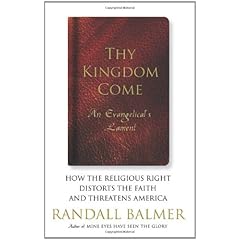
Or at least the preface.
This morning I started reading Thy Kingdom Come, An Evangelical's Lament--How The Religious Right Distorts The Faith And Threatens America.
These are the first two paragraphs--
"I write as a jilted lover. The evangelical faith that nurtured me as a child and sustains me as an adult has been hijacked by right-wing zealots who have distorted the gospel of Jesus Christ, defaulted on the noble legacy of nineteenth-century evangelical activism, and failed to appreciate the genius of the First Amendment. They appear not to have read the same New Testament that I open before me every morning at the kitchen counter. When they do quote the Bible, they wrench passages out of context and offer pinched, literalistic interpretations--of the Genesis account of creation, for instance--that diminish the scriptures by robbing them of their larger meaning.
The effect of this right-wing takeover has been a poisoning of public discourse and a distortion of the faith. Leaders of the Religious Right have managed to persuade many of my fellow evangelical Christians that it is something akin to sin to vote for anyone who is not a Republican, a perception that the Republican Party has done nothing to discourage. Since its formation in the late 1970s, the Religious Right, a loose federation of politically conservative evangelicals, has become the Republican Party's most reliable constituency, supplying the base of volunteers and voters that organized labor once provided for the Democratic Party."
I'm thrilled with this book so far because it is completely lacking in any of the name calling and general nastiness that comes with politics these days. (Although I must admit I do enjoy that sort of thing when it comes from Al Franken.) And I'm practically giddy about the first chapter--Strange Bedfellows: The Abortion Myth, Homosexuality, and the Ruse of Selective Literalism. I'm so tired of "morality"= anti-abortion, anti-gay marriage, end of story. Let's all forget about war, genocide, poverty, oppression, destruction of God's creation for profit,
etc.

Speaking of politics, why is Ann Coulter so mean? Some people say it's because she's actually a man. After seeing her legs, I'm pretty much convinced. So knowing that and how tortured her soul must be to psychologically turn on herself like that and become a radically hateful Right Wing (son of a?) bitch in order to stamp out her former identity, I feel absolute compassion for her. Say a prayer for Ann today.
Speaking of transexuality, we saw Transamerica last night. Felicity Huffman is AMAZING! The whole male prostitution thing was difficult, but I would still highly recommend it . . . the film, not male prostitution.
(Someday I'm going to review a NEW movie . . . really.)
Monday, October 02, 2006
Radical Environmentalism--It's Not All Tofu and Biking To Work
We're wrapping up our science study on energy, force, simple machines, blah, blah, blah. Today we did a recap of everything and I found myself reading this aloud to Moira--
"It is very important that we learn how to use energy carefully. . . If we use less energy, there will be less pollution. The precious fossil fuel supplies will last a lot longer."
--Energy: Get Moving by Wendy Sadler
But this is stupid. Don't people realize that the longer we act out this namby pamby pseudo environmentalism the longer we'll be dependent on fossil fuel? Don't people realize that scientists don't invent new technology and governments don't implement said technology until there's a crisis.
So I propose a new kind of radical environmentalism--use up the fossil fuel as fast as possible. We should do everything we can to waste energy. Instead of walking next door to see your neighbor, you should re-park your car closer to their door and then get out and knock. We should leave all the lights on all the time. Run the air conditioner and the heat at the same time in order to balance everything to 70 degrees. (Maybe this isn't possible right now, but we can work on it.) We should run our appliances even when we don't need to. If the noise of the blender gets to be too much, you can just turn up the stereo and the tv which should already be on anyway.
This kind of treehugging will really get things done. Create a crisis that will demand change! Necessity is the mother of invention and if those scientists wake up one morning to find that OOPS! overnight the whole world ran out of fossil fuel and they need to make a fire from sticks to boil water they collect from outside to make the coffee they have to grind with a hammer, they'll get their butts in gear. So let's get to work and use up that energy in order to inconvenience the scientists and world leaders into action.
And I am officially no longer mocking the people with environmental stickers on the bumpers of their SUVs. I'm just embarrassed I didn't recognize the TRUE radicals.
Monday, September 25, 2006
Yet Another Left To Tell Quote
"As we drove away from my home, past the unmarked mounds of dirt that covered Mother and [my brother], I felt the bitter, dirty taste of hatred in my mouth. On the return trip I looked at the faces peering at us ass we passed, and I knew with all my heart that those people had blood on their hands—their neighbors’ blood . . . my family’s blood. I wanted the soldiers to douse [the town] in gasoline and let me light the match that would reduce it to ashes.
I went straight to bed when we arrived at the camp without talking to anyone. My soul was at war with itself. I’d struggled so hard to forgive but now felt duped for having done so; I had no clemency left in me. Seeing my home in ruins and visiting the lonely, forgotten graves of my loved ones had choked the life out of my forgiving spirit. When my neighbors whispered the stories of my family’s sadistic murders in my ear, the feelings of hatred that I thought I’d banished from my soul sprang violently from the depths of my being with renewed vigor. My heart hungered for revenge, and I raged inside myself. Those bloody animals! They are animals, animals, animals!
I tossed and turned for hours. I knew the devil was tempting me—that he was leading me away from the light of God, from the freedom of His forgiveness. I could feel the weight of my negative thoughts dragging me away from the one light that had guided me through the darkness. I never felt lonelier than I did that night. God was my truest friend, and these feelings were a wall between us. I knew that my thoughts caused Him pain, and that knowledge tortured me.
I rolled out of bed and got down on my knees. “Forgive my evil thoughts, God,” I prayed. “Please . . . as You always have, take this pain from me and cleanse my heart. Fill me with the power of Your love and forgiveness. Those who did these horrible things are still Your children, so let me help them, and help me to forgive them. Oh, God, help me to love them.
A sudden rush of air flooded my lungs. I heaved a heavy sigh of relief, and my head dropped back on the pillow. I was at peace again. Yes, I was sad—deeply sad—but my sadness felt good. I let it embrace me and found that it was clean, with no tinge of bitterness or hatred. I missed my family desperately, but the anger that had gripped me like a returning malignancy was gone.
The people who’d hurt my family had hurt themselves even more, and they deserved my pity. There was no doubt that they had to be punished for their crimes against humanity and against God. There was already talk at the UN about creating an international tribunal to capture those responsible, and I prayed that it would happen. But I prayed for compassion as well. I asked God for the forgiveness that would end the cycle of hatred—hatred that was always dangerously close the surface.
I knew that my heart and mind would always be tempted to feel anger—to find blame and hate. But I resolved that when the negative feelings came upon me, I wouldn’t wait for them to grow or fester. I would always turn immediately to the Source of all true power: I would turn to God and let His love and forgiveness protect and save me."
I love this passage because it shows so clearly how humanity is not cut out for bitterness and hatred. Although we're very good at it, we can't sustain it--it will eat us alive. We don't have the capacity to maintain hatred and our humanity at the same time. So it is our choice--to lay anger down (even when it is completely justified) or to lose that beautiful spark God has given us--our humanity, that which makes us only a little less than the divine.
Thursday, September 14, 2006
The Switch To Beta
 Now Ben and I are combined on the same dashboard and I'm a little afraid something will get weird. I need my own blog identity after all.
So I'm going to test it with a quote I've been saving from a book I read months ago, Left To Tell. It's a beautiful book and I'll be posting a few quotes in the next few days. It's written by Immaculee Ilibagiza, a woman who survived the genocide in Rwanda but lost most of her family. The following is one of her thoughts during the months she spent hiding in a tiny (and I mean TINY) bathroom with 7 other women.
"I was certain that God had a greater purpose for me, and I prayed every day for Him to reveal it to me. At first I was expecting Him to show me my entire future all at once—maybe with a flash of lightning and a clap of thunder thrown in for good measure. But I came to learn that God never shows us something we aren’t ready to understand. Instead, He lets us see what we need to see, when we need to see it. He’ll wait until our eyes and hearts are open to Him, and then when we’re ready, He will plant our feet on the path that’s best for us . . . but it’s up to us to do the walking."
The whole book is as much a boost to faith as it is a challenge. If you haven't read it, I'd definitely urge you to do so.
Monday, July 10, 2006
Another Quote?!?
Oddly enough this comes from The Little Princess. I was reading it to the girls this afternoon and this bit really struck me.
"I wonder how many of the attics in this square are like that one, and how many wretched little servant girls sleep on such beds, while I toss on my down pillows, loaded and harassed by wealth . . ."
"My dear fellow," Mr. Carmichael answered cheerily, "the sooner you cease tormenting yourself the better it will be for you. If you possessed all the wealth of all the Indies, you could not set right all the discomforts in the world, and if you began to refurnish all the attics in this square, there would still remain all the attics in all the other squares and streets to put in order. And there you are!"
This is what so many of us think--the problems of the world are immense and the little we can do seems so pathetic in comparison that it's not even worth trying. But if you were a person in need, in terrible need, would you feel like helping just one person, when that person happened to be you, was a waste of time? Sure, global poverty was not solved, but, thanks to a little help, you now have a shot at a future. A waste? Sure, your living conditions are nowhere near those in the States, but you're healthy and content. A waste?
If we as individuals set out in this life to apply our resources--financial, emotional, and spiritual--to radically change just two other lives for the better, what would the world be like? Think exponentially. It would be tremendous.
Let's get to work!
Wednesday, July 05, 2006
Some Good Quotes (A Ridiculous Undertaking Since My Nails Are Too Long Right Now To Type Properly)
From Beginning The World--A Former Nun's Memoir of Her Painful but Triumphant Journey into Life by Karen Armstrong
"I had to leave the God I knew who dragged around with him the rags of my own past life with all its mistakes and misconceptions before I could really find Him again. I had created this 'God' in my own image and likeness and in the likeness of a mistaken system. Now I had to let Him go so that He could become Himself for me. If I wanted to find Him I had to lose Him first; this is--and I should have known it--a law of the spiritual life. Heaven knows I'd read enough books about it. This was, though I couldn't see it then, a positive step towards myself and towards God at the same time. But the loss was a real one and all I could feel at the time was the pain of the parting and, in a very real sense, a death."
". . . I knew that my basic belief in God was still alive. It could never be the same as it was. I'd had to leave behind the comforts of certainty and dogma. But a belief in the mysterious God [Father] Paul had spoken of persisted stubbornly, underneath all the pain and rubble of things I'd had to forget. At least, I thought it did. As I acknowledged that, I felt a sudden lift of joy and excitement. I had no idea where this new 'faith' was going to lead me, nor what it was exactly. I'd never be able to define it clearly, because God defied definition. But I knew that I'd spend the rest of my life trying to penetrate that thick cloud of unknowing."
And from the introduction to The Challenge of Jesus by N.T. Wright--
"The second reason why I engage in serious historical study of Jesus is out of loyalty to Scripture. This may seem deeply ironic to some on both sides of the old liberal-conservative divide. Many Jesus scholars of the last two centuries have of course thrown Scripture out of the window and reconstructed a Jesus quite different from what we find in the New Testament. But the proper answer to the approach is not simply to reassert that because we believe in the Bible we do not need to ask fresh questions about Jesus. As with God so with the Bible; just because our tradition tells us that the Bible says and means one thing or another, that does not excuse us from the challenging task of studying it afresh in the light of the best knowledge we have about its world and context, to see whether these things are indeed so. For me the dynamic of a commitment to Scripture is not 'we believe the Bible, so there is nothing more to be learned,' but rather 'we believe the Bible, so we had better discover all the things in it to which our traditions, including our "protestant" or "evangelical" traditions, which have supposed themselves to be "biblical" but are sometimes demonstrably not, have made us blind.' And this process of rethinking will include the hard and often threatening question of whether some things that our traditions have taken as 'literal' should be seen as 'metaphorical,' and perhaps also vice versa--and, if so, which ones."
Wednesday, June 07, 2006
Thank You, Michael Pollan, For Making Me Hate Myself
I just HAD to go and read my book right after I’d bought non-free-range eggs. I just didn’t have time to wait for my dad to drive an hour or so to Bucyrus to get eggs from the farm. Just a little inconvenient when you have a birthday cake to make NOW. If it weren’t for those farm eggs we’d probably have to give them up all together because there’s no possible way we could afford to buy those free-range eggs from the store.
Anyway, this is what I read in the Omnivore’s Dilemma the night of my despicable purchase—
“Egg operations are the worse from everything I’ve read; I haven’t managed to actually get into one of these places since journalists are unwelcome there. Beef cattle in America at least still live outdoors, albeit standing ankle-deep in their own waste eating a diet that makes them sick. And broiler chickens, although they get their beaks snipped off with a hot knife to keep them from cannibalizing one another under the stress of their confinement, at least don’t spend their lives in cages too small to ever stretch a wing.
"That fate is reserved for the American laying hen, who spends her brief span of days piled together with a half-dozen other hens in a wire cage the floor of which four pages of this book would carpet wall to wall. Every natural instinct of this hen is thwarted, leading to a range of behavioral “vices” that can include cannibalizing her cage mates and rubbing her breast against the wire mesh until it is completely bald and bleeding. (This is the chief reason broilers get a pass on caged life; to scar so much high-value breast meat would be bad business.) Pain? Suffering? Madness? The operative suspension of disbelief depends on the acceptance of more neutral descriptors, such as “vices” and “stereotypes” and “stress.” But whatever you want to call what goes on in those cages, the 10 percent or so of hens that can’t endure it and simply die is built into the cost of production. And when the output of the survivors begins to ebb, the hens will be “force-molted”—starved of food and water and light for several days in order to stimulate a final bout of egg laying before their life’s work is done.
"I know, simply reciting these facts, most of which are drawn from poultry trade magazines, makes me sound like one of the animal people, doesn’t it? I don’t mean to (remember, I got into this vegetarian deal assuming I could go on eating eggs), but this is what can happen to you when you . . . look. And what you see when you look is the cruelty—and the blindness to cruelty—required to produce eggs that can be sold for seventy-nine cents a dozen.
"A tension has always existed between the capitalist imperative to maximize efficiency at any cost and the moral imperatives of culture, which historically have served as a counterweight to the moral blindness of the market. This is another example of the cultural contradictions of capitalism—the tendency over time for the economic impulse to erode the moral underpinnings of society. Mercy toward the animals in our care is one such casualty.”
This book is really incredibly good. I like the fact that the author is not PETA at all. He’s interested in humane care for animals but not ready to dismiss domestic animals for food altogether. He really looks at all the angles and turns up many implications that aren’t first glance apparent. It’s a real eye-opener that I recommend to anyone who . . . eats.
Friday, June 02, 2006
New Favorite Quote (And I guess I need to clarify that I'm being facetious)
"The feminist agenda is not about equal rights for women. It is about a socialist, anti-family political movement that encourages women to leave their husbands, kill their children, practice witchcraft, destroy capitalism and to become lesbians."
Kudos for anyone who can guess who said it.
Kudos for anyone who can guess who said it.
Thursday, May 25, 2006
Found This Quote Last Night
Through violence you may murder a murderer, but you can't murder murder.
Through violence you may murder a liar, but you can't establish truth.
Through violence you may murder a hater, but you can't murder hate.
Darkness cannot put out darkness. Only light can do that.
--Martin Luther King, Jr.
Through violence you may murder a liar, but you can't establish truth.
Through violence you may murder a hater, but you can't murder hate.
Darkness cannot put out darkness. Only light can do that.
--Martin Luther King, Jr.
Thursday, April 27, 2006

Wednesday, April 19, 2006
I Think I'm an Anne Lamott Addict
I have to blame Kerri's blog for this. She reminded me of Anne Lamott with her posts about Traveling Mercies. (You can see them here and here. ) This reminded me that I had always wanted to read Anne Lamott's book Bird by Bird so I headed off to the library. But once there in the Anne Lamott non-fiction section I started greedily snatching her other books from the shelves and now I've become quite the addict. I've practically been inhaling her books. I can't get enough.
Then I became even more pathetic, because my Anne Lamott binging coincided with her guest appearance (or maybe guest invisibility since it was radio) on Wait, Wait Don't Tell Me. Ben got to watch me hyperventilate and almost choke on my pancakes when I heard she was going to be on the show. What is wrong with me?
When I first encountered Anne Lamott I remember being intrigued but a little put off by her. She certainly wasn't my kind of Christian. But that was years ago and I'm definitely in a different place now. I think "flake" would be the term to define me right now. I still don't agree with some of her views (she's quite the pro-choicer) but so much of what she says is powerful and faith inspiring. She's so open about what she's thinking and feeling (both good and bad) that it gives you a literary kick in the pants to go out into the world and be yourself and do the best you can to follow God and love other people.
Her stories make it clear that we will fail, we'll blow it, make mistakes and humiliate ourselves in the process, but if we can get beyond that (easier said than done), if we can let go of the fear of making mistakes, there will be times when we will succeed in amazing ways. We'll be the people that bring God's love to someone else in just the right way. We just don't know what that right way is. There's no formula to loving people and living life for God, we just have to show up and hope we see what He wants us to do.
That's what Anne Lamott talks about the most--muddling through this life with all its pitfalls and tragedies and doing the best we can to bring goodness into the world.
So I'll leave you with a quote (not as long as Kerri's excerpts because I'm not that great of a typist)--
"I have a lot of faith. But I am also afraid a lot. I remembered something Father Tom had told me--that the opposite of faith is not doubt, but certainty. Certainty is missing the point entirely. Faith includes noticing the mess, the emptiness and discomfort, and letting it be there until some light returns. Faith also means reaching deep within, for the sense one was born with, the sense, for example, to go for a walk."
From Plan B, Further Thoughts On Faith
Sunday, April 16, 2006
Easter
Easter is so profound. Christmas was an afterthought in the early Church, the birth not observed for a few hundred years. But no one could help noticing the resurrection: "Spring is Christ," Rumi said, "martyred plants rising up from their shrouds." Easter says that love is more powerful than death; bigger than the dark, bigger than cancer, bigger than airport security lines.
--Anne Lamott, Plan B

--Anne Lamott, Plan B
Subscribe to:
Posts (Atom)


